Canadian researchers find a simple cure for cancer, but major pharmaceutical companies are not interested.
Researchers at the University of Alberta, in Edmonton, Canada have cured cancer last week, yet there is a little ripple in the news or in TV. It is a simple technique using very basic drug. The method employs dichloroacetate, which is currently used to treat metabolic disorders. So, there is no concern of side effects or about their long term effects.
This drug doesn't require a patent, so anyone can employ it widely and cheaply compared to the costly cancer drugs produced by major pharmaceutical companies.
Canadian scientists tested this dichloroacetate (DCA) on human's cells; it killed lung, breast and brain cancer cells and left the healthy cells alone. It was tested on Rats inflicted with severe tumors; their cells shrank when they were fed with water supplemented with DCA. The drug is widely available and the technique is easy to use, why the major drug companies are not involved? Or the Media interested in this find?
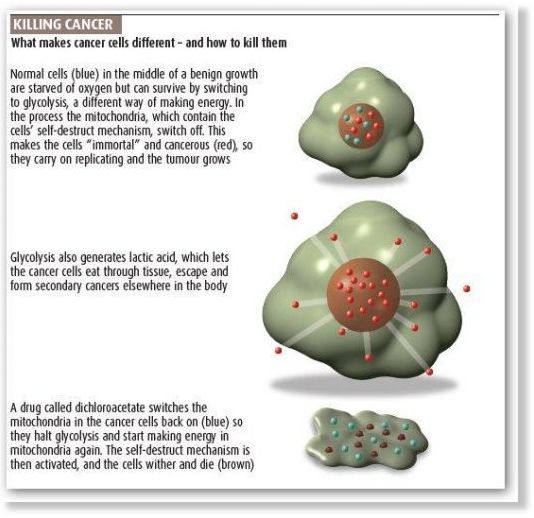
In human bodies there is a natural cancer fighting human cell, the mitochondria, but they need to be triggered to be effective. Scientists used to think that these mitochondria cells were damaged and thus ineffective against cancer. So they used to focus on glycolysis, which is less effective in curing cancer and more wasteful. The drug manufacturers focused on this glycolysis method to fight cancer. This DCA on the other hand doesn't rely on glycolysis instead on mitochondria; it triggers the mitochondria which in turn fights the cancer cells.
The side effect of this is it also reactivates a process called apoptosis. You see, mitochondria contain an all-too-important self-destruct button that can't be pressed in cancer cells. Without it, tumors grow larger as cells refuse to be extinguished. Fully functioning mitochondria, thanks to DCA, can once again die.
With glycolysis turned off, the body produces less lactic acid, so the bad tissue around cancer cells doesn't break down and seed new tumors.
Pharmaceutical companies are not investing in this research because DCA method cannot be patented, without a patent they can't make money, like they are doing now with their AIDS Patent. Since the pharmaceutical companies won't develop this, the article says other independent laboratories should start producing this drug and do more research to confirm all the above findings and produce drugs. All the groundwork can be done in collaboration with the Universities, who will be glad to assist in such research and can develop an effective drug for curing cancer.
You can access the original research for this cancer here.
This article wants to raise awareness for this study, hope some independent companies and small startup will pick up this idea and produce these drugs, because the big companies won't touch it for a long time.
Microsoft's Bing uses Facebook data to personalise search
Bing, Microsoft’s search engine, has introduced a deeper integration with Facebook, in a bid to help users navigate the web through the ‘likes’ of their friends on the social network.
Bing has updated its privacy settings
By Emma Barnett, Digital Media Editor1:28PM BST 17 May 2011
People using Bing to search for information, will need to be logged into Facebook to take advantage of the new tool, which shows users what sites and services their friends have used and recommended within the body of the results.
The move is a similar one to when Google launched social search, incorporating Twitter and Facebook feeds into its search results.
However, this initiative goes a step further by actually displaying Facebook user’s commentary on sites and services just beneath the search results.
Bing powers the search engine on Facebook, so it is thought it can delve deeper into the sites data for the purposes of optimising search.
Microsoft said the decision to launch a more social search was down to research it commissioned which found that 90 per cent of people seek advice from family and friends as part of the decision-making process – the so-called ‘friend effect’.
“Starting today, you can receive personalized search results based on the opinions of your friends by simply signing into Facebook. New features make it easier to see what your Facebook friends “like” across the web, incorporate the collective know-how of the web into your search results, and begin adding a more conversational aspect to your searches,”wrote Yusuf Mehdi, corporate vice-president, Microsoft, on the company’s search blog.
“Decisions can now be made with more than facts, now the opinions of your trusted friends and the collective wisdom of the web.
“You can quickly see what your friends like and are sharing. Find and connect with the right friends faster. Pick the brains of friends of who live where you’re travelling and share shopping lists with your own team of retail gurus. And, return the favour to your friends by liking more things on the Web. With one click you can let your network know that you like a brand, an article, a celebrity or even a place.”
Sign at Ashland, Oregon station. (Thanks to Katcha Sanderson for the photo.)
Two Roosevelt dimes contain 0.14468 oz of silver. If gas costs $4 in FRNs, then the implicit price of silver that makes $4 equivalent to 0.14468 oz of silver is $27.65 per ounce. So, this price seems roughly in the ballpark. But, if we take $35, which is nearer today’s silver’s price, then the implied price of gasoline is $5.06, which is steep. At any price less than $5.06, I’d hold on to the dimes and use FRNs. One has to be careful about these things. One also needs a conversion table. This could be sold as an application on a handheld device. I’m giving away a profitable idea here. The device could read in the spot price of silver from a web site. The user punches in the FRN price. Then the equivalent amount of silver coin is the output.
Do you have any U.S. coins from before 1977? Some of those coins are actually 90% silver in weight and now sell for up to 20 U.S. paper dollars.
Do you know how much your coins are worth? This calculator will help you convert back and forth between silver coins and U.S. paper dollars.Find out the prices of “junk silver” coins from the U.S. Mint including: pre-1965 dimes, pre-1965 quarters, pre-1965 half dollars, pre-1965 dollars, half dollars from 1965 to 1970, and dollars from 1971 to 1976 from the San Francisco mint. Don’t see a coin or currency that you’re looking for? Let us know.
The iPhone app has been submitted to Apple for approval. Whenever they get around to approving it, I’ll update this post. In the mean time, you can use the web based application found here.
Black Barry App
Still looking for a BB app developer to help with this project. If someone has a BlackBerry, could you please try this online version and see if it works? Possible Online BlackBerry Application
How To Identify Members Of The Collectivist Fringe
Tuesday, 17 May 2011 04:39 Brandon Smith
There is a mysterious, devious, and violent movement out there on the fringe of American society.Its tendencies are destructive, its theories and ideologies are absurd and unfounded, and its influence is growing to the point of cultural eruption.Its goal is to destabilize the legal constructs and philosophical principles which founded this country and replace them with a new social model so far outside rational guidelines it can only be described as “fantasy land on PCP.”
Now, if you are one of the random indoctrinated idiots out there that has already assumed I am describing the Sovereign Citizens Movement, Constitutionalists, or so called “right wing extremists”, then you have answered incorrectly, you receive no consolation prize, and you go home empty handed on top of being completely inept.Hang your head in shame...
I am certainly not describing Constitutionalists, who have never been a “fringe movement”, and never will be.I am not talking about Sovereign Citizens, who, thanks to a recent and very poorly executed 60 Minutes hit piece, are now superficially lumped in with every conceivable villain known to man, including Terry Nichols, Jerry and Joseph Kane, racism in general, and the ever nefarious Wesley Snipes (who did, I admit, play a villain in the movie ‘Demolition Man’).
This rancid piece of festering half-assed journalism is a laughable example of a clueless and outdated mainstream media desperately trying to tap the propaganda vein of the average American dupe.Luckily, the only people left on the planet that actually watch ‘60 Minutes’ for news value are all senile geriatrics who are about 60 minutes from death anyway.However, the hit piece does represent very well the particular movement I am describing.
Some call them “Statists”, others call them “Globalists”, or “Collectivists”.I usually call them all of the above.They represent a much smaller portion of the U.S. population than is often imagined, but like the venomous blowfish of the ocean deep, they have the ability to “puff up”, giving the illusion that they are ten times their actual size, as well as having a propensity for poison.Collectivist rhetoric is enjoying a considerable foothold in the U.S., building over several decades to culminate in what amounts to a slow motion Chinese-style “Cultural Revolution”.A complete disintegration of traditional social principles, the destruction of philosophical and political checks and balances, the total rewriting of historical fact to suit the supplanting agenda, as well as the rampant and fanatical demonization of anyone who supports and defends the “old way”.
Such a movement has no boundaries.It only stops when it has assimilated EVERYTHING, and never before.It is used as a tool by oligarchy (fascist, communist, corporatist; their attributes are all essentially the same) to mold nations and manipulate civilizations to follow a single directive, a single path, a single historical narrative.The collectivist methodology is one of centralization, fealty, and feudalism.The most prominent monsters in the history of man have all been collectivists, or at least public proponents of collectivism.
So, how do we go about identifying one of these creatures, or their drooling disciples, and root them out?Well, since establishment shills like those featured on 60 Minutes seem perfectly at ease with the idea of making generalizations to pigeonhole entire subsections of the citizenry, I feel quite comfortable targeting them with the same brand of fire.At least I will have the decency to be a little more specific in my descriptions, and far more accurate.Here are some sure signs of a collectivist extremist…
1)Maligned and ridiculed during most of childhood and adolescence.Felt powerless for most of life and probably still feels powerless in adulthood.Discovered the effectiveness of single minded groups very early, and has been a “joiner” ever since.Feels a rush when immersed in a mob, and thirsts for the control, dominance, and acceptance that the mob commands.Certain types become absolutely addicted to law, legal structures, and the bureaucratic machine, to the point that they are unable to discern between a just law, and an unjust law.To them, ALL law instituted by a power structure such as government is “just”, regardless of moral conflict. This leads to a worshipful attitude towards mainstream designated leadership figures.
Becoming an appendage of the state gives them the petty authority over others that they never had when they were young, and they love it.They despise anyone who questions the legitimacy of their authority, or authority in general.They have handed over everything to the collective, including their identity, and their soul.To come across someone who is not weak like them, who has the strength of character to make their own way, on their own terms, and who is fearless in the face of overwhelming opposition, forces them to acknowledge their own cowardice and deeply buried regrets.This, of course, infuriates them…
2)See themselves as “intellectual”, or rather, far more ingenious than the majority of people.This would be fine if they actually were intelligent, but in fact, this is rarely the case.Average collectivists tend to be undereducated, slow witted, and easily manipulated, but because they have conformed to the establishment social model so thoroughly, they still find themselves climbing the ladder of “success” (success in today’s typical business environment usually includes backstabbing and/or shameless butt kissing).This gives them severe delusions of grandeur.It is common to hear them rant about overpopulation, and the need to “weed out the inferiors”, of which they obviously do not include themselves, but should.
Their world view has been entirely scripted for them, and rarely is an original thought ever uttered from their lips.Anyone who presents a view outside of the mainstream script is automatically and viciously attacked.A very common collectivist reaction to any opposing view is to use Ad hominem tactics to disparage the person presenting the view, instead of confronting their view directly.The 60 Minute segment above is simply one long Ad hominem attack linking anyone who promotes Constitutionalist ideals or anti-establishment arguments with killers, racists, and terrorists (The father of one of the police officers slain by the Kane’s claims that if his son had know they were “Sovereign Citizens”, he would still be alive today; insinuating that ANYONE who makes sovereignty arguments should be considered armed and dangerous by police, and treated as guilty before proven innocent).Collectivists use these kinds of tactics for the most part because they do not have the mental capacity to defend their twisted ideals with any vigor, and would surely lose a fair debate on neutral ground.
3)Constantly pushing a new angle; a “magic bullet” solution to all the problems of the world, which usually seems to include more centralization, more government micromanagement of our resources, our economy, our education, and our lives.Certain types believe that technology will somehow undo all the failings of humanity in one fell swoop.Tales of floating cities, infinite energy, unlimited abundance, and a labor-free society, are spun by collectivists with much excitement but with no practical concrete planning as to how to reach such a Utopia.“If only everyone realized how brilliant they are, how fantastic their ideas are.If only everyone thought exactly as they do, the Earth would truly be a better place…” they think to themselves.“If only everyone would shut up and do as they’re told…”
4)Attacks tradition with a cultish fervor.Preaches ad nauseam about the need for social evolution, but fails to acknowledge that one of the primary fundamentals of evolution is to hold onto that which makes an organism stronger, and outgrow that which makes it weaker.Just because a concept is “new”, it does not necessarily make it superior to concepts that are supposedly old.Collectivists regularly undercut the values of the Constitution, or free markets, for example, as being outdated and obsolete, even though they have rarely if ever actually experienced a constitutionally regulated environment, or commerce that is truly free from subversion.Because collectivists are weak people, the idea of legitimate strength is foreign to them.Therefore, they fill the void with whatever “appears” strong, or trailblazing, and leave behind all ideas they do not understand, which is a considerable number.
5)Believe the family is subject to the whims of the state, and that parents are not to be trusted with the development of their children.Now, certainly, there are plenty of terrible parents in the world, and some of them don’t deserve the families that they have, however, as far as the education of children is concerned, the state is hardly a better teacher.Attributes most often given to governments through the ages include:lying, cheating, stealing, murder, subjugation, and remorselessness.Is this really who we want raising our children?“Yes”, say collectivists.
Ever wonder why the rather harmless institution of homeschooling is brought up so frequently in MSM hit pieces like the one above, or in DHS official releases like the MIAC report on domestic terrorism?Because it represents independence from the system.It is an avenue by which any family can decouple, at least partially, from the establishment and make their own decisions.This kind of activity is an affront to the collectivist ideology.Hell, if our government is willing to set its sights on a group as passive and non-threatening as the Amish, of course they are willing to go after homeshoolers!
6)Has the ability to rationalize almost anything in the name of the system.Always proclaiming the necessity of peace, but insist peace only on their terms.Abhor violence in words, but in action, they bathe in it.Ultimately, they see the “group” as a single entity whose survival is paramount over all other concerns, including individual freedom.To protect this entity, they will forgo any obstacles of conscience, even, ironically, to the point that the group self destructs.Without a healthy appreciation of the vitality of the individual, all “groups” revert to chaos and self mutilation.Without the individual, the group cannot function.It cannot exist.
New Cultural Revolution To Destroy America?
The psychologist Carl Jung, overwhelmed by the ignorance of communist and collectivist movements given birth in his lifetime, often stated that if a man thinks he can abandon history, if he thinks he can exist without the teachings of the past, without connections to that which came before him, without individual relationships to cultural memory, then he is literally diseased.He is insane.Not surprisingly, most collectivists hate Jung.For, through his studies, he exposed the undeniable madness of centralization; a methodology that thrives on amnesia, reaps only catastrophe, and hurtles societies into the abyss.
For a collectivist movement to take hold, it MUST erase root values, not to mention as much of the past as possible from the minds of the masses, and replace it with distraction.Sometimes its war, sometimes its poverty or famine, sometimes it’s another segment of the population that is villainized on the sacrificial alter of “progress”.In China, this kind of restructuring of the public mind has been going on for decades, but nothing quite compares to the Cultural Revolution triggered by Mao in 1966.
Even before the communist revolution in 1949, China was a globalist experiment; a Petri dish where international players could create one social virus after another and let them loose to play.During the Cultural Revolution, China saw the radicalization first of the country’s youth in the name of the state, then most others followed.The promise of change gave the Chinese a false impression of rebellion.A fake rebellion driven by a fake agenda and a fake enemy.Mobilized by ignorance and the need for identity, the Chinese people were used by Mao as weapon to destroy his political rivals, as well as anyone who dared question the righteousness of the state.For ten years, anyone with enough common sense to see the hypocrisy and the lunacy of the Chinese communist system lived in fear for their lives.One misspoken word, one slip of the tongue, and millions of ears would be listening.Even those who had served the government without question would sometimes be singled out for persecution, for a statist religion needs a constant flow of enemies to destroy, to keep the people enraptured, and keep them in line.Watch the short documentary on the Cultural Revolution below very carefully, and ask yourself how far down this path has America gone?
Some might say that this kind of swing of the pendulum is not possible in the U.S., but look at the lines we have crossed so far!Our educational system has been revamped to misinform the next generation and even remove entire chunks of important history from their curriculum.The Constitution was once considered one of the most important living documents in history by many peoples, not just Americans.Now, owning one is listed as a possible sign of “homegrown extremism” by the Department of Homeland Security and the same government that is tasked with defending the liberties described within it.At every turn we hear arguments that our principles must be abandoned to make way for better, more “globally conscious” alternatives.That we must “forget the past”.And, those of us who refuse to forget the past are hoisted up on the vile stage of the MSM, forced to wear signs (labels) and paraded as criminal malcontents out to maim and kill poor unsuspecting collectivists and undermine the “legitimacy” of the government.In my opinion, we are not far off at all from the depravity of Mao’s China.
I leave you with a video of the post-Bin Laden Seal Team 6 action death (still without any concrete independently corroborated evidence that it ever actually occurred) celebration, and the unfortunate mindless drones who came out en masse without even knowing why.Compare with the documentary on China above, and then decide how far some Americans have gone down the endless well of the hive mind:
You can contact Brandon Smith at: brandon@altmarket.comThis e-mail address is being protected from spambots. You need JavaScript enabled to view it
Want to protect your savings from inflation? Want to invest in precious metals but don't know where to begin? Contact Kirk Elliott at:
The war on terror is a worldwide endeavor that has spurred massive investment into the global surveillance industry, which now seems to be becoming a war on “liberty and privacy.” Given all of the new monitoring technology being implemented, the uproar over warrantless wiretaps now seems moot.
High-tech, first-world countries are being tracked, traced, and databased, literally around every corner. Governments, aided by private companies, are gathering a mountain of information on average citizens who so far seem willing to trade liberty for supposed security. Here are just some of the ways the matrix of data is being collected:
GPS -- Global positioning chips are now appearing in everything from U.S. passports and cell phones to cars. More common uses include tracking employees, and for all forms of private investigation. Apple recently announced they are collecting the precise location of iPhone users via GPS for public viewing in addition to spying on users in other ways.
Internet -- Internet browsers are recording your every move forming detailed cookies on your activities. The National Security Administration has been exposed as having cookies on their site that don't expire until 2035. Major search engines know where you surfed last summer, and online purchases are databased, supposedly for advertising and customer service uses. IP addresses are collected and even made public. Controversial websites can be flagged internally by government
Advertisement
RFID -- Forget your credit cards which are meticulously tracked, or the membership cards for things so insignificant as movie rentals which require your Social Security number. Everyone has Costco, CVS, grocery-chain cards, and a wallet or purse full of many more. RFID “proximity cards” take tracking to a new level in uses ranging from loyalty cards, student ID, physical access, and computer network access. Latest developments include an RFID powder developed by Hitachi, for which the multitude of uses are endless -- perhaps including tracking hard currency so we can't even keep cash undetected. (Also see microchips below).
Traffic cameras -- License plate recognition has been used to remotely automate duties of the traffic police in the United States, but have been proven to have dual use in England such as to mark activists under the Terrorism Act. Perhaps the most common use will be to raise money and shore up budget deficits via traffic violations, but uses may descend to such “Big Brother” tactics as monitors telling pedestrians not to litter as talking cameras already do in the UK.
Computer cameras and microphones -- The fact that laptops -- contributed by taxpayers -- spied on public school children (at home) is outrageous. Years ago Google began officially to use computer “audio fingerprinting” for advertising uses. They have admitted to working with the NSA, the premier surveillance network in the world. Private communications companies already have been exposed routing communications to the NSA. Now, keyword tools -- typed and spoken -- link to the global security matrix.
Public sound surveillance -- This technology has come a long way from only being able to detect gunshots in public areas, to now listening in to whispers for dangerous “keywords.” This technology has been launched in Europe to “monitor conversations” to detect “verbal aggression” in public places. Sound Intelligence is the manufacturer of technology to analyze speech, and their website touts how it can easily be integrated into other systems.
Biometrics -- The most popular biometric authentication scheme employed for the last few years has been Iris Recognition. The main applications are entry control, ATMs and government programs. Recently, network companies and governments have utilized biometric authentication including fingerprint analysis, iris recognition, voice recognition, or combinations of these for use in national identification cards.
DNA -- Blood from babies has been taken for all people under the age of 38. In England, DNA was sent to secret databases from routine heel prick tests. Several reports have revealed covert Pentagon databases of DNA for “terrorists” and now DNA from all American citizens is databased. Digital DNA is now being used as well to combat hackers.
Microchips -- Microsoft's HealthVault and VeriMed partnership is to create RFID implantable microchips. Microchips for tracking our precious pets is becoming commonplace and serves to condition us to accept putting them in our children in the future. The FDA has already approved this technology for humans and is marketing it as a medical miracle, again for our safety.
Facial recognition -- Anonymity in public is over. Admittedly used at President Obama's campaign events, sporting events, and most recently at the G8/G20 protests in Canada. This technology is also harvesting data from Facebook images and surely will be tied into the street “traffic” cameras.
All of this is leading to Predictive Behavior Technology -- It is not enough to have logged and charted where we have been; the surveillance state wants to know where we are going through psychological profiling. It's been marketed for such uses as blocking hackers. Things seem to have advanced to a point where a truly scientific Orwellian world is at hand. It is estimated that computers know to a 93 percent accuracy where you will be, before you make your first move. Nanotech is slated to play a big role in going even further as scientists are using nanoparticles to directly influence behavior and decision making.
Many of us are asking: What would someone do with all of this information to keep us tracked, traced, and databased? It seems the designers have no regard for the right to privacy and desire to become the Controllers of us all.
Terry Olgin owns 3rd Eye Computer Service, a managed service provider business, and is a member of the Redwood Technology Consortium. Check out his blog at terryolgin.wordpress.com . He can be reached at 3rdeyecomputers@gmail.com.
California is the eighth largest economy in the world, and it has a debt burden to match. It has outstanding general obligation bonds and revenue bonds of $158 billion, largely incurred for infrastructure. Of this tab, $70 billion is just for interest. Over $7 billion of California’s annual budget goes to pay interest on the state’s debt.
As large as California’s liabilities are, they are exceeded by its assets, which are sufficient to capitalize a bank rivaling any in the world. That’s the idea behind Assembly Bill 750, introduced by Assemblyman Ben Hueso of San Diego, which would establish a blue ribbon task force to consider the viability of creating the California Investment Trust, a state bank receiving deposits of state funds. Instead of relying on Wall Street banks for credit – or allowing a Wall Street bank to enjoy the benefits of lending its capital – California may decide to create its own, publicly-owned bank.
On May 2, AB 750 moved out of the Banking and Finance Committee with only one nay vote and is now on its way to the Appropriations Committee. Three unions submitted their support for the bill – the California Nurses Association, the California Firefighters, and the California Labor Council. The state bank idea also got a nod from former Secretary of Labor Robert Reich in his speech at the California Democratic Convention in Sacramento the previous day.
Why a State Bank?
California joins eleven other states that have introduced bills to form state-owned banks or to study their feasibility. Eight of these bills were introduced just since January, including in Oregon, Washington State, Massachusetts, Arizona, Maryland, New Mexico, Maine and California. Illinois, Virginia, Hawaii and Louisiana introduced similar bills in 2010. For links, dates and text, see here.
All of these bills were inspired by the Bank of North Dakota (BND), currently the nation’s only state-owned bank. While other states are teetering on bankruptcy, the state of North Dakota continues to report surpluses. On April 20, the BND reported profits for 2010 of $62 million, setting a record for the seventh straight year. The BND’s profits belong to the citizens and are produced without taxation.
The BND partners with local banks in providing much-needed credit for local businesses and homeowners. It also helps with state and local government funding. When North Dakota went over-budget a few years ago, according to the bank’s president Eric Hardmeyer, the BND acted as a rainy day fund for the state. And when a North Dakota town suffered a massive flood, the BND provided emergency credit lines to the city. Having a cheap and readily available credit line with the state’s own bank reduces the need for massive rainy-day funds (which are largely invested in out-of-state banks at very modest interest).
The Center for State Innovation, based in Madison, Wisconsin, was commissioned to do detailed analyses for the Washington and Oregon bills. Their conclusion was that a state-owned bank on the model of the Bank of North Dakota would have a substantial positive impact in those states, increasing employment, new lending, and government revenue.
What California Could Do with Its Own Bank
Banks create “bank credit” from capital and deposits, as explained here. Under existing capital requirements, $8 in capital can be leveraged into $100 in loans, drawing on the liquidity provided by the deposits to clear the outgoing checks. Assuming a 10% reserve requirement (the amount in deposits normally held in reserve), $8 in capital and $100 in deposits are sufficient to create $90 in loans ($100 less $10 held back for reserves).
In North Dakota (population 647,000), the Bank of North Dakota has $2.7 billion in deposits, or $4000 per capita. The majority of these deposits are drawn from the state’s own revenues. The bank has nearly the same sum ($2.6 billion) in outstanding loans.
California has 37 million people. If the California Investment Trust (CIT) performed like the BND, it might amass $148 billion in deposits. With $12 billion in capital, this $148 billion could generate $133 billion in credit for the state (subtracting 10%, or 14.8 billion, to satisfy reserve requirements).
There are various ways the state could come up with the capital, but one possibility that would not require new taxes or debt would be to simply draw on the treasurer’s existing pooled money investment account, which currently contains $65 billion in accumulated revenues dispersed to a variety of funds. This money is already invested; a portion could just be shifted to the CIT. Since it would be an investment in equity rather than an expenditure, it would not cost the state money. Rather, it would make money for the state. In recent years, the Bank of North Dakota has had a return on equity of 25-26%. Compare the 25-30% lost in the two years following the 2008 banking crisis by CalPERS, the California Public Employees’ Retirement System, which invested its money on Wall Street.
There are many inviting possibilities for applying the CIT’s $133 billion in credit power, but here is one easy alternative that illustrates the cost-effectiveness of the approach. Assume the bank invested $133 billion in municipal bonds at 5% interest. This would give the state close to $7 billion annually in interest income – nearly enough to pay the interest tab on the state’s debt.
Choosing Prosperity
What California can do with its own bank, other states can do as well, on a scale proportionate to their populations and economies. North Dakota has a population that is less than 1/10th the size of Los Angeles; the BND produced $62 million in revenue last year and $2.2 billion in loans. Larger states could generate much more.
We have been trapped in an austere neo-liberal economic model in which the only alternatives are to slash services, raise taxes, and sell off public assets, all in a futile attempt to “balance the budget” in a shrinking economy. We need to start thinking outside the box. We can choose prosperity, and public banks are a key tool for achieving that end.
Ellen Brown wrote this article for YES! Magazine. Ellen is an attorney and president of the Public Banking Institute, http://PublicBankingInstitute.org. In Web of Debt, her latest of eleven books, she shows how people can reclaim the power to create money. Her websites are http://webofdebt.com and http://ellenbrown.com.